Currently Reading

The Broken Vow by Luisa A. Jones
Published: 22nd January 2024
Showing posts with label General Fiction. Show all posts

Sunday, 15 December 2024

REVIEW: The Ice Cream Girls by Dorothy Koomson


The Ice Cream Girls (Poppy & Serena #1) by Dorothy Koomson
Genre: Contemporary fiction, Drama, Crime
Read: 15th December 2024
Published: 1st March 2010

★★★★★ 5 stars

DESCRIPTION:

As teenagers, Poppy Carlisle and Serena Gorringe were the only witnesses to a tragic event. Amid heated public debate, the two seemingly glamorous teens were dubbed 'The Ice Cream Girls' by the press and were dealt with by the courts.

Years later, having led very different lives, Poppy is keen to set the record straight about what really happened, while Serena wants no one in her present to find out about her past. But some secrets will not stay buried - and if theirs is revealed, everything will become a living hell all over again. . .

Gripping, thought-provoking and heart-warming, THE ICE CREAM GIRLS will make you wonder if you can ever truly know the people you love.


MY THOUGHTS:

I first read this book about ten years ago and it resonated with me then. I decided to read it again because I wanted to read the sequel and found myself a little puzzled at its beginning because the story I remembered was the TV adapation which I have only recently rewatched for about the third time. It was picking up the sequel that I realised the TV adaption of the first book bore some striking differences to what actually happened in the book. And so I decided to read it again.

Reading it the second time around gave me a fresh understanding of the plight of both women. As teenagers in the 80s, they had the misfortune of falling in love with the same man. Their teacher. Most of us have had a crush on a teacher at some point in our lives, but this went way beyond that. And their teacher, Marcus Halnsley, abused his position of trust and authority by preyinh on, grooming and abusing these girls.

Poppy and Serena were not friends. Their paths may never have crossed had it not been for Marcus. And because each were sleeping with the others' boyfriend, they also hated one another. But Marcus played them against each other. And as a predator, he was charming, clever and manipulative. Poppy and Serena fell for his charms and were lulled into a false sense of security, believing the lies he fed them, playing them against the other. He made them into the women they were to become...and continued to haunt them from beyond the grave.

The story begins with Poppy's release from prison after twenty years for Marcus' murder. But she is single-minded in her purpose upon freedom - to find Serena and make her confess. Because if Poppy didn't kill Marcus,  Serena must have.

It's a shame that Poppy and Serena weren't friends because they were so alike in many ways, yet so different in others. Serena had a strength that Poppy lacked but she had a naivety about her. They both did. That's what attracted Marcus to them in the first place. But I think Poppy was even moreso.

I liked Poppy and felt for her having not only suffered at Marcus' hands but then the justice system. I believed in her innocence. I also felt for Serena but thought she should have been honest with her husband from the beginning. I understand her reticence but Marcus couldn't hurt her any longer. These two women suffered sexual, physical and psychological abuse for over two years at his hands. Their scars ran deep.

The story unfolds in alternating chapters from Poppy and Serena's perspectives as they struggle to move on with their lives but find themselves reliving the past. This is a very dark and emotional tale that exposes the heart and soul of the characters.

I enjoyed it just as much as I did the first time around. However, I must point out a constant mistake Ms Koomson made throughout the book. She referred to the girls having broken the first commandment - citing it as being "Thou shalt not kill". It is not the first commandment - which is actually "Thou shalt not have any gods before me" - but rather the sixth commandment. An error that should have been picked up and rectified upon editing. But still a brave and heartfelt story nonetheless.


MEET THE AUTHOR:

Books and reading have been a huge part of Dorothy Koomson's life since she was very young. Her mother taught her – and her siblings – to read and write when she was in nursery. As she got older, she used to go to the library every day after school to read books where she used to write short descriptive passages all the time. Whiling away many, many hours daydreaming and creating stories in her head.

At the grand old age of 13, she wrote my first novel called "There’s A Thin Line Between Love And Hate". She would write a chapter every night in her exercise books then pass it around to her fellow convent school pupils the next morning.

Dorothy grew up in London and then grew up again in Leeds when she went to university at Trinity and All Saints College (as it was then). She later returned to London to study for her masters degree in journalism at Goldsmiths University. She had various temping jobs and eventually became a journalist and editor working on various women’s magazines and national papers.

While working as a journalist, Dorothy continued to write short stories and novels in every spare moment – like on the train to and from work – as way to achieve her goal of becoming a published novelist. In 2001 she had the idea for "The Cupid Effect" and signed up with her first publisher a year later. In 2003 "The Cupid Effect" went on sale and her career as a published novelist began.

In 2006, her third novel, "My Best Friend’s Girl" was published. It was incredibly successful – selling nearly 90,000 copies within its first few weeks. Six weeks later, it was selected for the Richard & Judy Summer Reads Book Club and the book went on to sell over 500,000 copies. Because of its huge sales, it won an award. Her fourth novel, "Marshmallows for Breakfast", also won an award for selling over 250,000 copies.

In 2005 Dorothy moved to Australia and spent two years living in Sydney. When she returned to England in 2007 she moved to the south coast, namely Brighton. She love living by the sea. There’s nothing like a good walk along the seafront to clear your head or to work out the knots in a plot.

Those who’ve read her later books will know that a lot of them have been set in Brighton and its surrounding area, often with a good dose of Leeds and South London thrown in.

Social Media links:


Monday, 28 August 2023

REVIEW: The Will by Rebecca Reid


The Will by Rebecca Reid
Genre: General fiction, Mystery
Read: 27th August 2023
Published: 3rd November 2022

★★★★ 4 stars

DESCRIPTION:

The Mordaunts aren't like most families . . .

For one, their family home is Roxborough Hall - a magnificent, centuries-old mansion in the Norfolk countryside. For another, the house isn't passed down from parent to child - but rather to the family member deemed most worthy.

Cecily Mordaunt is dead. On the evening of her funeral, her family will gather for dinner and each will be given a letter, revealing who is the next custodian of Roxborough Hall.

The house is a burden, a millstone, a full-time job . . . but they all want it. And some are willing do anything to get it.


MY THOUGHTS:

One family. Eight letters. Who will get what they deserve...?

What a thoroughly entertaining read. Reading about wills and entails was slightly reminiscent of the early "Downton Abbey" days when no one knew who was to take up the reigns as Downton's heir apparent, with the estate being entailed down the line to male heirs. THE WILL is somewhat different in that respect...in a lot of respects, in fact...with the entail being decided by she who now holds the reigns.

The Mordaunt family extended have been summoned. Matriarch Cecily Mordaunt has died. And now the fate of Roxborough Hall on its sprawling Norfolk estate lay with the entail. A letter to each of them explaining why he or she did or not inherit the beautiful historic stately home. This is how it has always been done since the 1600s. A letter is given to all those in line to inherit with the one deemed most worthy to receive it bequeathed the vast estate. So who will it be?

David, the eldest but rather pompous son, and his ghastly second wife Bryony? Or maybe it's the youngest son, aging playboy Grant? It couldn't be Cecily's only daughter Elspeth, who hasn't graced Roxoborough's halls for three decades vowing never to return...could it? Or what about the grandchildren? David's daughters from his first marriage - Lizzie and Willa? Or even Jonty, Grant's adopted son? Who of these are the most deserving? Who wants Roxoborough the most? And who needs it the most? And more importantly, what plans do each of them have for Roxborough should they inherit?

Overseeing everything is Cecily's lifelong companion Violet, who first joined her as a ladies maid on her 21st birthday in the 1958. But what if Cecily left Roxborough to Violet? Surely not? She is, when all is said and done, basically a servant. A servant? Owning Roxborough Hall? The family would be a laughing stock. But who knows with flighty Cecily?

THE WILL is a twisty character-driven whogetsit with a vast array of character hopefuls. Almost everyone has a reason for wanting Roxborough but only one of them will get it. Who will it be?

I quite enjoyed this romp through the Norfolk countryside by way of Roxborough Hall. I did guess one major plot twist involving two of the characters and what a long buried secret meant to them. But the reason everyone has gathered to find out which one of them has been bequeathed Roxborough is the piece-de-resistance in a clever fait accompli delivered by Cecily herself.

A deliciously deviled tale filled to the brim with secrets. I especially love the flashback chapters which might seem a bit random at first but their place within the story comes at exactly the right time. Thoroughly entertaining.

I would like to thank #RebeccaReid, #Netgalley and #RandomHousePenguin for an ARC of #TheWill in exchange for an honest review.


MEET THE AUTHOR:

Rebecca is a freelance journalist. She is a columnist for the Telegraph Women’s section and has written for Marie Claire, the Guardian, Metro.co.uk, the Saturday Telegraph, the Independent, Stylist, Glamour, the iPaper, the Guardian, Indy100, LOOK and the New Statesman amongst others. Rebecca is a regular contributor to Sky News and ITV’s This Morning as well as appearing on Radio 4’s Woman’s Hour, LBC, BBC News 24 and the BBC World Service to discuss her work.

She graduated from Royal Holloway’s Creative Writing MA in 2015. She is the author of Perfect Liars, Truth Hurts, Two Wrongs and The Power of Rude.

Rebecca lives in North London with her husband.

Social media links:

Twitter | Instagram | Goodreads

Friday, 25 March 2022

REVIEW: Mrs Boots Goes to War by Deborah Carr


Mrs Boots Goes to War (Mrs Boots #3) by Deborah Carr 
Genre: Historical fiction, WW1, Sagas, General fiction
Read: 24th March 2022
Published: 19th February 2021

★★★★★ 5 stars

DESCRIPTION:

The world is at war and her country needs her

When Florence’s son, John, announces that he has enlisted, she is horrified but determined to hold her family together during the oncoming hardships they are to face.

Men are returning to England wounded, with many more not returning at all, families are struggling, and Florence's ‘Dear Girls’ are risking their lives in new and dangerous jobs. Florence might be older now, but she has no intention of sitting back on her laurels while others fight for King and Country. She knows what needs to be done…


MY REVIEW:

It has been way too long since I read the first two books in the Mrs Boots series, "Mrs Boots" and "Mrs Boots of Pelham Street", but I soon picked up the story finding myself once against immersed within life with the Boots at St Heilers House in Nottingham. 

The first book introduces a young Florence Rowe on the island of Jersey where she was born and grew up working and living above her father's stationery shop, before meeting Jesse Boot. The couple marry against her mother's staunch wishes, as she did not want to see Florence tied to an older husband and ultimately becoming his nursemaid. But the marriage of Florence and Jesse was the beginning of the Boots pharmaceutical empire that Britons still know and enjoy today. The second book expands on their growing empire as well as their family which sees them move to a much bigger house which they name St Heilers, in honour of Florence's roots on Jersey. The growth of their business sees them opening more stores with Pelham Street being their main base. Now in this third installment MRS BOOTS GOES TO WAR, a new challenge meets Florence and her family with the onslaught of the Great War.

Seven years prior, Jesse had been knighted for his service as a businessman with his expanding empire, and Florence was therefore now known as Lady Boot. Now the year is 1913, the old Queen Victoria has passed in 1901 as has her successor King Edward VII in 1910 and now King George V reigns. Tensions are rising in Europe with rumbles of a war in their midst whilst Florence and Jesse welcome the marriage of their eldest daughter Dorothy to Captain Wilfrid Bruce. By the time September 1914 has come around, war has broken out and Florence is shocked to learn her only son John has enlisted and is being sent to France just four weeks after his marriage to wife Margaret.

Meanwhile their youngest daughter Margery is restless after both her older siblings have married and in light of both her sister and sister in law expecting their first children. Margery had contemplated joining the suffrage movement prior to the war and wanted to make a difference to others in life, thus leading her to announce her determination to go to Northern France to help in her own way with the war effort. Florence now has to resign herself that two of her children will be so close to the Front, where danger is most imminent. But it's where she feels she can truly make a difference. After all, that is how Florence and Jesse raised their children.

At home in Nottingham, Florence finds herself dealing with many of "her dear girls", as she always thinks of them, handing in their notice with the lure of higher wages being offered in the nearby munitions factory. She has heard of the "canary girls", so nicknamed for the yellow pallor of their skin handling such toxic chemicals causes. However, the work is extremely dangerous and Florence can't help but fear for the young girls who leave her employ to take on such perilous work for a few extra shillings. But then she remembers that these girls are from working class families and every extra they can earn helps. Even so, Florence continues to help out the families of her employees in any way that she can throughout the difficult times they are all facing.

At the news of the alarming gas attacks inflicted on their men in France, Jesse came up with the idea of producing some kind of gas mask to help their men if ever they come under further attacks. This leads to the production of many other items they can offer the men at the Front. In this way, Jesse and Florence feel they at Boots are doing their own bit for the war effort with the people they employ to manufacture these products also.

With all the changes, Florence continues to remain positive despite and help others where she can, despite her own fears for her children. When the war begins to come a little too close to home with Zeppelin raids over the country, it seems only a matter of time when tragedy will strike someone close to them. For a war that everyone would be over by Christmas that first year, it just seems to continue throughout the coming years with no end in sight thus plummeting those left at home into despair. Florence does her level best to remain positive though it is tough. Her one shining light, besides her work with the Boots empire, is her grandchildren and the delight they bring her whenever she sees them with Jesse being her strength.

Together, Florence and Jesse are stalwarts in their partnership, going from strength to strength as their empire booms despite the decimating war in Europe. As a woman, Florence was many years ahead of her time and other women, a philanthropist in her own right with a partnership that was unique bringing a pharmaceutical empire to the forefront of a nation who still enjoy it today.

Based on the actual story behind the Boots empire, MRS BOOTS GOES TO WAR continues where the other two books left off and taking readers into a much darker time for Britons and for Florence and Jesse themselves. In this third book, Jesse is far more infirm than he has been previously with his health having deteriorated to the point he was physically limited in his capabilities. But his handicap did not stop him from continuing with the Boots empire. And as there was no mention in the Author's Note at the end, I have to wonder is there to be a further chapter to the Boots story? As Jesse lives a further decade and thensome after the end of this book...with Florence seeing yet another war come and go, another two Kings come and go, almost reaching her ninth decade herself. I would love to read more of Florence and her family, as I feel though this is a fitting end there is still more to be told.

There was more than one occasion I found myself getting a little emotional and shedding a few tears, as is usually the case when the senseless act of war is concerned. But what touches me most is the strength of the family unit Florence and Jesse have built within their children as well as in their stores and factories.

MRS BOOTS GOES TO WAR is well written and incredibly well researched that I was captivated from the very beginning. The author really brings each of the characters to life as well as the period itself. I felt as if I was living through WW1 myself it felt that real. It is also interesting to draw the parallels between the onset of the Spanish flu at the end of the war with our own pandemic we face today.

Whilst this is a series, MRS BOOTS GOES TO WAR can suffice as a standalone if you haven't read the other books. But to appreciate it in its entirety, I thoroughly recommend going back to where it all began...when Florence was a shop girl in Jersey and meets a man thirteen years her senior who comes to the island for his health. And the rest, they say is history. 

I absolutely love this series and, while I hope for more of Florence and Jesse, this one does offer a fitting end should the series finish here. MRS BOOTS GOES TO WAR is a thoroughly enjoyable read that was light and easy that is emotive and inspiring. I have no hesitation in recommending to anyone who enjoys historical fiction.

I would like to thank #DeborahCarr, #Netgalley, #OneMoreChapter for an ARC of #MrsBootsGoesToWar in exchange for an honest review.


MEET THE AUTHOR:

Deborah Carr was born on the island of Jersey and writes historical novels under her own name. Her First World War historical romance, Broken Faces was runner-up in the 2012 Good Housekeeping Novel Writing Competition and received a ‘special commendation’ in the Harry Bowling Prize. In 2017, she was commissioned to write The Poppy Field to commemorate the 100th anniversary of the end of the First World War.

Deborah's historical novels have a connection to Jersey, Channel Islands where she lives. Her latest book, An Island At War recently became a USA Today Besteller and is set in Jersey during The Occupation which took place when the German forces invaded the island in the summer of 1940 until liberation on 9th May 1945. Her Mrs Boots series is inspired by Jersey woman Florence Boot, the woman behind the Boots empire. Mrs Boots (Book 1), Mrs Boots of Pelham Street (Book 2), and Mrs Boots Goes To War (Book 3). Deborah is hoping to be able to announce two further standalone novels coming soon from One More Chapter.

Deborah also writes contemporary romance series as Georgina Troy, signing up to the Romantic Novelist’s Association New Writers’ Scheme in 2005 and became a full member when A Jersey Kiss was published. This book is the first book in her Jersey Scene series and was a finalist in the Joan Hessayon Award for New Writers 2015 and Contemporary Romance Category, Romantic Novel of the Year Awards 2016 (RoNAs). Her second four-book series, also set in Jersey is The Boardwalk by the Sea. She also recently signed with the brilliant Boldwood Books who will be bringing out the first books in her new Sunshine Island series, Finding Love on Sunshine Island in May 2022.

As if that wasn't enough, Deborah has also written two psychological suspense novels for Hera Books as Ella Drummond. My Last Lie and The Darkest Summer are out now in e-book and audio book.

Deborah has lived most of her life on the island of Jersey where she now lives a few minutes from the beach with her husband and three adorable but noisy dogs.
 
Social Media links:


Tuesday, 1 February 2022

REVIEW: The Orphan in the Peacock Shawl by AnneMarie Brear


The Orphan in the Peacock Shawl
Genre: Historical fiction, General fiction, Victorian Era
Read: 26th January 2022
Published: 27th January 2022

★★★★★ 5 stars

DESCRIPTION:

Yorkshire Dales 1850

As a terrible storm rages, Annabelle Wallis is shocked to find a distressed young woman at her cottage door, heavy with child. Moments later a baby girl is born. But by dawn, the mother has vanished, leaving behind the helpless child wrapped only in a silk peacock shawl.

When news spreads that Lady Eliza Hartley, sister to wealthy estate owner, John Hartley, has been found dead, Annabelle realises the terrible secret she has stumbled on. Terrified she’ll be blamed for Eliza’s death, Annabelle flees to the filthy slums of York, where she plans to raise the precious orphan as her own.

The cobbled streets of York’s slums are no place for a young woman like Annabelle or a Hartley babe and John Hartley is determined to bring them both home. But Annabelle proves impossible to find.

Annabelle can’t hide forever from the wealthy Hartley family, but can she ever give up the baby she loves?


MY REVIEW:

My first read by author AnneMarie Brear and what a delightful read it is! As soon as I began I was swept away back to the Victorian era of the windswept Yorkshire Dales to the foetid slums of York. The author's descriptions were vivid enough to picture them without being bogged down in overt detail whilst bringing a realism to the tale. Almost at once I felt like I was reading Catherine Cookson or Dilly Court, both of whom I adore. Needless to say, I read this book in one sitting one afternoon...I could not put it down until I finished.

Set in the Yorkshire Dales in 1850, Annabelle Wallis lives in a cottage on the edge of the estate of the wealthy Hartley family. She is an orphan whose mother entrusted her to her friend Amy Wallis, an herbalist known locally as Widow Wallis having lost her husband in a tragic accident fifty years before. Widow Wallis saved the life of the then Lady Hartley and, in a gesture of gratitude, was granted lifetime occupancy of the cottage in which she and Annabelle now live. Villagers come to her for tonics and herbal remedies for their ailments, swearing by her tinctures, as well as being entrusted as their unofficial midwife as the need arises. 

Annabelle has always viewed her guardian as her mother, referring to her as Ma who has taught twenty two year Annabelle everything she knows about herbs and their uses. Together they frequent markets and fairs selling their tonics and remedies which are indeed sought after. But Ma is aging, though she has never revealed her true age, and when she dies suddenly Annabelle is bereft. Now everything she has ever known is about to change. The only home she has ever known, the cottage she has grown up in, will now revert back to the Hartley estate thus rendering her homeless.

But a chance encounter with John Hartley, brother of the owner of the estate, and a promise that she may remain sets Annabelle's heart aflutter. The moment she and John Hartley set eyes on each other, it is obvious to everyone but them that they are meant for each other...except for the slight technicality of the class divide. He is a wealthy landowner, she is working class...and never the twain shall meet. Except that it does. Neither Annabelle nor John can stop thinking of the other, although neither of them give their feelings a voice. Instead they pretend it isn't there whilst avoiding the other.

And then one night in the midst of an horrific thunderstorm, a knock at Annabelle's door reveals a young woman heavy with child and very obviously in the throes of labour. She pleads with Annabelle to help her deliver the child without the aid of a doctor. Moments later, a baby girl is born and the woman extracts a vehement promise from Annabelle to keep her secret. By the morning, the woman has vanished leaving behind a note reminding Annabelle of her a promise and her baby wrapped only in a silk peacock shawl.

The following day when news spreads throughout the village about the sudden death of Lady Eliza Hartley, Annabelle fears the promise she made was a foolish one. Especially when the family discovers the truth thus holding her to blame. Terrified, Annabelle flees the only home she has known with the child wrapped in the peacock shawl, intent on honouring the promise she made.

When John Hartley discovers the truth, he endeavours to find Annabelle and the child. But Annabelle proves hard to find...and yet, she cannot hide forever. Can she? But if she is found, will she be able to give up the child she has raised and loves as her own?

THE ORPHAN IN THE PEACOCK SHAWL is a delightfully easy read from beginning to end, reminiscent of the late great Catherine Cookson. The descriptions were vivid without being too much and the characters were well-developed enough to cheer them on. I loved the characters of Annabelle and John, as well as those of Ginny and Dickie, though he was persistently annoying at first. The fact that Annabelle draws her parallels to her own circumstances was incredibly noble in doing the same that her Ma did for her by taking in this child. 

I found THE ORPHAN IN THE PEACOCK SHAWL incredibly easy to read and did so in one sitting, easily immersing the reader into the Victorian era with seamless and expert storytelling. Although predictable, it's the journey we are taken on that makes it so enjoyable. It's simple, it's sweet and an absolute pleasure to read. I was thoroughly absorbed from start to finish.

THE ORPHAN IN THE PEACOCK SHAWL is perfect for fans of Dilly Court and Catherine Cookson.

I would like to thank #AnneMarieBrear, #Netgalley, #BoldwoodBooks and #RachelsRandomResources for an ARC of #TheOrphanInThePeacockShawl in exchange for an honest review.


MEET THE AUTHOR:

AnneMarie Brear was born in a small town in N.S.W. Australia, to English parents from Yorkshire, and is the youngest of five children. From an early age she loved reading, working her way through the Enid Blyton stories, before moving onto Catherine Cookson’s novels as a teenager. 

Living in England during the 1980s and more recently, AnneMarie developed a love of history from visiting grand old English houses and this grew into a fascination with what may have happened behind their walls over their long existence. 

Her enjoyment of visiting old country estates and castles when travelling and, her interest in genealogy and researching her family tree, has been put to good use, providing backgrounds and names for her historical novels which are mainly set in Yorkshire or Australia between Victorian times and WWII. 

A long and winding road to publication led to her first novel being published in 2006. She has now published over twenty-seven historical family saga novels, becoming an Amazon UK best seller and with her novel, The Slum Angel, winning a gold medal at the USA Reader's Favourite International Awards in 2019, and a silver medal for The Market Stall Girl in 2021. Two of her books have been nominated for the Romance Writer’s Australia Ruby Award and the In’dtale Magazine Rone award.

AnneMarie now lives in the Southern Highlands of N.S.W. Australia with her husband and her family.

Social Media links:


PUBLISHER:


Stay up to date with upcoming releases from Boldwood Books by following them on these social media accounts.


Saturday, 22 January 2022

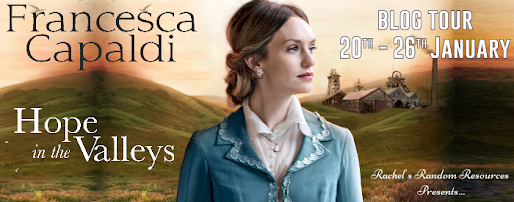
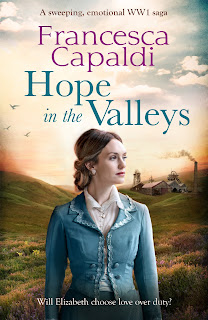
REVIEW: Hope in the Valleys by Francesca Capaldi


Hope in the Valleys (Wartime in the Valleys #3) by Francesca Capaldi
Genre: Historical fiction, Sagas, WW1
Read: 15th January 2022
Published: 20th January 2022

★★★★★ 5 stars


DESCRIPTION:

Will Elizabeth choose love over duty?

It’s August 1917 and WW1 continues to take a toll. The villagers of Dorcalon, a mining village in the Rhymney Valley, try to keep hope alive; but every day brings fresh tragedy as more of their sons and fathers are killed on foreign battlefields.

Elizabeth Meredith, daughter of mine manager Herbert, enjoys a privileged position in the village, but she longs to break free of society’s expectations.

Falling in love with miner, Gwilym Owen, brings more joy to her life than she’s ever known… until she’s forced to choose between her love and her disapproving family. Seeking an escape, Elizabeth signs up as a VAD nurse and is swiftly sent to help the troops in France, even as her heart breaks at leaving Gwilym behind.

Separated by society and the Great War, can Elizabeth and Gwilym find their way back together again? Or will their love become another casualty of war?


MY REVIEW:

As soon as I read the dedication page to Rosemary Goodacre, author of the Derwent Chronicles who sadly passed away just days before her last book was published in October 2020, I knew this was going to be a good book. I loved the Derwent Chornicles and despite having never come across Francesca Capaldi before, I devoured HOPE IN THE VALLEYS within a day. I did not, however, realise it was part of a series and the more I read the more I felt like I had missed out on quite a bit that had gone on beforehand...but don't worry, the author does a brilliant job of keeping readers informed as to what has previously occurred so we don't feel as though we really missed out after all. Having said that, since I thoroughly enjoyed this book, I certainly intend on going back and reading the first two at some stage.

It's August 1917 and the Great War continues to rage across Europe claiming many British men despite the belief that it would be over by Christmas the first year...that being 1914. Three years later and it shows no signs of letting up as the small Welsh mining village or Dorcalon in the Rhymney Valley reels from the losses of their sons and fathers in the trenches. Although mining is a dangerous occupation, it is a reserved one and therefore keeping many sons and fathers of villagers from being conscripted into the Army. But mining is not without its dangers with a mine explosion and collapse some 18 months ago which claimed a couple of lives.

Elizabeth is the daughter of the mine manager Herbert Meredith, a fair man who believes in his workers even if the coal company doesn't. He believes that they too should be receiving the same wages as other coal mines as well as the bank holiday others enjoy. Unfortunately the decision is not his to make. Given his position, Elizabeth is able to enjoy a privileged lifestyle and status of the middle class...and yet it is not something of any importance to her. She longs to be free of the social expectations her mother has placed on her and at twenty-seven is expected to settle for whatever suitable husband her mother Margaret can find her. But Elizabeth will not be bullied into a marriage to a man of social standing that she doesn't love. But her mother is quick to claim what has love got to do with it?

Gwilyn Owen is a miner, working class and most unsuitable marriage material for Elizabeth in her mother's eyes. He is a quiet man but a proud one and though he knows nothing can come of his romance with Elizabeth, he loves her just the same...and she him. But as soon as her mother gets wind of the dalliance she is affronted both by the deception and Elizabeth's unsuitable choice. She forbids her to have anything more to do with him or she will see he is dismissed from his position in the mines and encourages her to find a more suitable match. Such as one of Lady Fitzgerald's sons Sidney, a Captain, or Horace, a Lieutenant - the fact that they are officers speaks volumes as to their social standing and suitability. But Elizabeth couldn't think of anything worse. So in an act of rebellion she packs her bags and flees to join the VAD (Voluntary Aid Dispatch) nurse and is sent to France to work in a casualty clearing hospital near the Front, leaving both her family and her love behind.

Not only divided by society, Elizabeth and Gwilym are now separated by war and a continent. In a letter she left for Gwilym, Elizabeth explained their unsuitability and that she was a fool to allow it to continue, leaving Gwilym brokenhearted. In an attempt to dismiss all thoughts of Elizabeth from his mind, he sets to work on the allotment he and Elizabeth had set as a cooperative initiative for villagers to grow their own produce in the wake of rationing and shortages.

Meanwhile, Gwen Austin had been working in a munitions factory some miles away but due to the nature of the job, became ill and was hospitalised with a toxic poisoning as a result of her job. She was advised complete rest for the coming months and not to return to her former employment. So when Margaret Meredith is told her maid is leaving to get married, she knows she must find a replacement quick and soon discovers Gwen is looking for work. The pair come to an understanding and Gwen begins her new job at MacKenzie House which is a far cry from that of the munitions factory.

Life takes a turn for both Elizabeth and Gwen as they fight to overcome social stigmas for their place in life and love. And as the end of the war seems to be drawing closer, another fight is on their hands...one that could prove far more dangerous than war.

HOPE IN THE VALLEYS is a wonderful story of love, loss, friends and family as the world changes in the wake of the Great War and the carnage that it leaves behind. It's a story of social divide between the classes as those that dare to cross it bring a sense of change. It's a story of war and of hope.

I quickly felt at home with the pages as I drew similarities to Rosemary Goodacres "The Derwent Chronicles", also centred around a village with social divides and WW1. I enjoyed my journey to the Welsh mining town even if some of the Welsh phrases and language were a little lost on me (even google didn't help with some of them) but it didn't detract my enjoyment of the story.

HOPE IN THE VALLEYS is a delightfully easy read in which the characters who had featured in the first two books are feature here, though the focus in this installment is mostly on Elizabeth and Gwen. Some of the characters you really love to hate - such as Elizabeth's mother Margaret who is so completely overbearing, for one, amongst others - while others are completely endearing.

I have no hesitation in recommending HOPE IN THE VALLEYS to fans of historical fiction sagas such as Rosemary Goodacre, Dilly Court and Catherine Cookson.

I would like to thank #FrancescaCapaldi, #Netgalley, #HeraBooks and #RachelsRandomResources for an ARC of #HopeInTheValleys in exchange for an honest review.


MEET THE AUTHOR:

Francesca has enjoyed writing since she was a child, largely influenced by a Welsh mother who was good at improvised story telling. A history graduate and qualified teacher, she decided to turn her writing hobby into a career in 2006. She is a member of the Romantic Novelists' Association and the Society of Women Writers and Journalists. Each month she writes a competition post for the Romantic Novelists' Association blog.


Social Media links:


Monday, 27 December 2021

REVIEW: The Girl Behind the Gates by Brenda Davies


The Girl Behind the Gates by Brenda Davies
Genre: Historical fiction, Contemporary fiction, Women's fiction, True stories
Read: 27th December 2021
Published: 23rd July 2020

★★★★★ 5 stars

DESCRIPTION:

1939. Seventeen-year-old Nora Jennings has spent her life secure in the certainty of a bright, happy future - until one night of passion has more catastrophic consequences than she ever could have anticipated. Labelled a moral defective and sectioned under the Mental Deficiency Act, she is forced to endure years of unspeakable cruelty at the hands of those who are supposed to care for her.

1981. When psychiatrist Janet Humphreys comes across Nora, heavily institutionalised and still living in the hospital more than forty years after her incarceration, she knows that she must be the one to help Nora rediscover what it is to live. But as she works to help Nora overcome her past, Janet realises she must finally face her own.

Based on a true story, The Girl Behind the Gates is perfect for fans of The Girl in the Letter and Philomena.


MY REVIEW:

Wow! There are no words to describe how this book made me feel. Well, there are...but where to start? THE GIRL BEHIND THE GATES is compelling, haunting and chilling in the first half while poignant, raw and redeeming in the second half. Like the two halves, it is divided into two parts that each tell a different story of the same journey. It is heartbreaking and harrowing but so completely touching by its end.

I have long been familiar with the archaic concept of committing young women who find themselves pregnant out of wedlock to mental asylums and while in today's society we cannot comprehend such treatment, it was once a common occurrence. One has to remember that psychiatry was a relatively unknown field and the treatments given were pretty much all they knew, however that was no excuse for some of the treatment and abuse dealt out to patients for no reason whatsoever but to exert a sense of power. This story is a fictional account based on actual events of an idealistic and privileged young girl who finds herself in the most harrowing of circumstances through which most of us could probably never survive.

1939: Seventeen year old Nora Jennings is in love. She also has a secret. Finding herself pregnant by her cousin Robert, Nora tries to hide her growing stomach from her strict father who thinks nothing of beating her into submission and obedience. Upon discovering her condition, her parents call upon the local priest and family GP who, after a humiliating examination to ascertain the pregnancy, then drag her from the house, her parents giving her no backward glance, and is taken to Hillingsworth hospital known as the local mental asylum where she is sectioned under the Mental Deficiency Act of 1913.

Diagnosed as morally defective, Nora is then subjected to the harsh realities behind the walls which had until then seemed a surreal fantasy. She receives no visitors but for the family housekeeper, Mrs Lampeter, who doted on Nora like a mother and whom Nora loves like a mother. When her baby is born, as Nora is deemed morally defective any offspring she produces is regarded as such also, and so the cruel and nasty Sister Cummings leaves the little girl naked to die in the sluice room. Nora never even got to hold her baby or even know of its sex.

As the years progress, Nora makes a sort of peace with herself and is comforted by the thought that her baby was adopted and grew up feeling loved. But a shocking revelation brought the horrible truth crashing down sending Nora into a downward spiral from which she intended never to recover. That is, until a kind and caring doctor on her ward made it his mission to look out for her and upon learning of her catatonic state, attempted to bring her back from the brink. And yet despite this, the cruelties and harsh treatments doled out to the patients of Hillingsworth, Nora continued to suffer more indignities as every basic human right that we all take for granted was taken away from her bit by bit.

1981: Although she has the ability to fix others' fractured lives, psychiatrist Janet Humphreys' own personal life is in disarray. She works long hours, is never home and even when she is she is absent, leaving her husband feeling unloved and unwanted. In an act of desperation, he leaves her and despite this, Janet soldiers on. She has to. She has patients who depend on her. And one of them is Nora Jennings who, after over forty years at Hillingsworth, is completely institutionalised. Although life became easier in the later years when Sister Cummings was dismissed, Nora simply found it is easier to succumb to whatever was asked of her.

When Janet comes across Nora's case file, she is intrigued. She meets Nora in the hospital's "back ward" of long forgotten patients who have been there for decades. At first Nora is silent, apprehensive and untrusting. After all, the only people she had any form of contact with were cruel and abused their authority, aside from a handful of nurses who were at least kind. And Dr Stilworth who always stood up for her and helped her when all others took away any liberties she may have had. But then he retired. 

Now there is this new doctor...and Nora is unsure whether she can trust her. Because anyone she places her trust in usually leaves her in the end. Joe did, Patty did, Dr Stilworth, even her parents...and Robert. Can she trust this Dr Janet? Or will she betray her too?

THE GIRL BEHIND THE GATES is a harrowing tale of one woman's journey cruelly snatched from her privileged life and thrown into a life of abuse and torture at the hands of those who are meant to be caring for her. Deemed morally defective because she fell pregnant at 17 and was unmarried...as if no one else was to blame for the consequence of the act that creates a baby. Not only that, but any offspring she produces would therefore be also considered morally defective by the defective gene passed down from her mother. What rot! It angered me to read such rubbish but angered me even more that this was a fact that people actually believed. And sadly, as psychiatry was a relatively unknown field at the time, doctors simply had to go with what they knew...and this is what they knew. It was all the tools they had at the time. But that's not the only angering part of this story. It's the harsh treatment of patients, or inmates as they were often referred to like they were prisoners...and they were in a sense, because they could never escape the walls that bound them there. As if beating a patient and calling her a whore who deserved everything she got wasn't bad enough, but the wet wraps they were subjected to...for simply grieving a loss! It's barbaric. Wet wraps are a form of torture and it was heartbreaking to read that such treatment existed...and for what purpose?

Four decades of abuse, torture, humiliation and loss. Four decades of isolation, grief and adversity. Four decades of such harsh treatment it's not surprising Nora was well and truly institutionalised. But when Janet enters the story in 1981, she brings with her hope and in the journey that follows highlights Nora's resilience, her stoic endurance and her survival against all odds.

THE GIRL BEHIND THE GATES is a heartbreaking read that is harrowing and chilling at times but shines a ray of hope on even the harshest of circumstances. I doubt I could have lived through and survived all that Nora had done and yet she did...and though the scars remained, her ability to rise above her trauma is inspiring.

Horrifying, shocking and compelling, THE GIRL BEHIND THE GATES is a heartbreaking yet beautiful story with which one will need tissues. And plenty of them. I could not stop the tears from falling as I read of Nora's harrowing treatment and the rejection of her basic human rights. What also angered me was that the country was at war with Germany over the Hitler's discardment of human rights and yet here they were stripping an innocent woman of the same. It defied logic. And another thing that annoyed me was that Robert could have intervened due to his authority and yet he didn't. Nora had no one. She was stripped of everything she had and was left to rot in Hillingsworth until Janet reached out and allowed her to see her true worth.

While Janet's personal life was an aside to the main story, I felt it paled in significance to Nora's journey and, while others failed to see whether it played a part or not, for me it showed that not only are psychiatrists human but the point that the author made at the beginning in her "Author's Note" was that Nora taught her and inspired her a great deal as well. In my view, Janet was inspired by Nora and her strength to make peace with her own past and the issues that plagued her marriage. It was Nora who gave her that.

A very powerful story, THE GIRL BEHIND THE GATES is not one I will forget in a hurry. I loved it, I hated it and I was moved by it entirely. Thank you to Brenda Davies for telling Nora's story...a story that needed to be told because as is the case with history - its purpose is for us to learn from, to remember and to never let it happen again.

I would like to thank #BrendaDavies, #Netgalley and #HodderAndStoughton for an ARC of #TheGirlBehindTheGates in exchange for an honest review.


MEET THE AUTHOR:

Dr Brenda Davies is Consultant Psychiatrist. She holds regular workshops around the world and includes many celebrities among her clients. Having been born and raised in County Durham, England, Brenda Davies now lives very happily in Wales. She spent many years living and working abroad, in Zambia, the USA, Germany and Rome. 

A lover of life and people, Brenda relishes challenge and adventure and believes that living all of our gifts simultaneously and loving doing so, is the epitome of life.

The Girl Behind the Gates is her first novel.

Social Media links:


Thursday, 14 October 2021

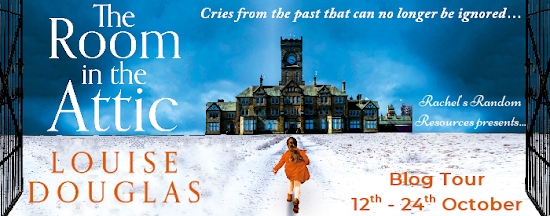
REVIEW: The Room in the Attic by Louise Douglas


The Room in the Attic by Louise Douglas
Genre: Historical fiction, Women's fiction, General fiction, Gothic
Read: 4th October 2021
Amazon
Published: 12th October 2021

★★★★★ 5 stars

DESCRIPTION:

A child who does not know her name…

In 1903 fishermen find a wrecked boat containing a woman, who has been badly beaten, and a young girl. An ambulance is sent for, and the two survivors are taken to All Hallows, the imposing asylum, hidden deep on Dartmoor. The woman remains in a coma, but the little girl, Harriet, awakens and is taken to an attic room, far away from the noise of the asylum, and is put in the care of Nurse Emma Everdeen.

Two motherless boys banished to boarding school…

In 1993, All Hallows is now a boarding school. Following his mother’s death and his father’s hasty remarriage, Lewis Tyler is banished to Dartmoor, stripped of his fashionable clothes, shorn of his long hair, and left feeling more alone than ever. There he meets Isak, another lost soul, and whilst refurbishment of the dormitories is taking place, the boys are marooned up in the attic, in an old wing of the school.

Cries and calls from the past that can no longer be ignored…

All Hallows is a building full of memories, whispers, cries from the past. As Lewis and Isak learn more about the fate of Harriet, and Nurse Emma’s desperate fight to keep the little girl safe, it soon becomes clear there are ghosts who are still restless.

Are they ghosts the boys hear at night in the room above, are they the unquiet souls from the asylum still caught between the walls? And can Lewis and Isak bring peace to All Hallows before the past breaks them first…


MY REVIEW:

Where do I begin? WOW! Just...WOW! This is my first foray into Louise Douglas and I wasn't sure what to expect...but THE ROOM IN THE ATTIC just blew me away! I can't even begin to categorise its genre...is it historical? Is it women's fiction? Is it a mystery? Is it even paranormal (which is not really my thing)? Basically, it's a bit of everything rolled into a gothic ghost story complete with a rambling asylum and strange noises in the attic. The plot is twisty, the scene is atmospheric and the characters are completely engaging. This book had me absorbed from the very first page right through the very last...so much so that I read it in one sitting! I began it when I went to bed, thinking I'd read for a couple of hours before hitting the hay, but noooo...I simply had to keep reading till the end...right up till 4.20am!

So the first thing that drew me to the book was the fact it was dual timeline. I love these types of books where two stories unfold and are seamlessly woven together by the end. But this one goes one step further than that which to say much more would be to reveal spoilers...and you really must read the book yourself to experience it. The other thing which drew me was the whole atmospheric setting of a creepy asylum on Dartmoor miles from anywhere and the mystery that unfolds there.

On a cold and rainy night in 1903, fishermen come across a seemingly deserted boat floating at sea off the Devon coast. Upon closer inspection they discover a young child and an unconscious woman laid out barely alive. Their rescuers take them to the local doctor who sedates the distressed young child and the two are transferred to All Hallows asylum on Dartmoor. There, the woman is given the Royal Suite where she is to be treated and recover in private away from the asylum's inmates whilst the child is taken into care by 70 year old nurse, Emma Everdeen who has lived most of her life at All Hallows. To protect the child from the inmates, both she and the nurse are secluded to the asylum's attic rooms until her mother has been nursed back to health.

But the child, whose name is Harriet, is reluctant to reveal any details about who they are or where they come from or where they may have been heading when they were found near death in the freezing waters. Emma slowly begins to extract information from the child and they form an unlikely alliance. Emma still grieves for the child she lost fifty years before and Harriet longs to be reunited with her mother. However, the woman shows no signs of waking from her comatose state and to reunite the pair now would only distress the child further. But the more time Emma spends with Harriet, the more she grows fond of the child and fears the time when she must hand her back to her mother. 

But something sinister is lurking beyond the walls of All Hallows and Emma feels a malevolence she can't explain and a desperate need to protect little Harriet. But at what cost?

Ninety years later in 1993, 13 year old Lewis Tyler has been shipped off to boarding school and finds himself billeted at All Hallows, now repurposed as a boarding school for boys. Misunderstood and grieving the loss of his mother, Lewis finds himself banished here when his father remarries. The school has recently suffered flood damage and with part of the west wing closed for renovations, Lewis is given accommodation in an attic room with one other student, Isak Salen

The boys begin a tentative friendship having been forced to share a room but soon find themselves sharing confidences and a shared interest in the history of All Hallows when it was an asylum, stemming from the skeletal remains Lewis uncovers in grounds outside of the asylum's graveyard. Lewis and Isak decide to solve the mystery of who the remains were and why they were buried in unconsecrated ground reserved for criminals. Added to that are the creaking noises they hear in the night as well as the shadows that pass their door. The wails and moans that appear to haunt the old asylum have them terrified and longing to uncover what is really rattling around up there. Their enquiries lead them to the school library where there is a nook specially devoted to the history of All Hallows and everything therein. And there they come across an old nursing manual that had once belonged to Emma Everdeen and an autobiography written by an inmate Thalia Nunes, as they endeavour to uncover what really happened in the room in the attic ninety years ago.

There are several themes highlighted throughout the story. The first being abandonment as Lewis, Isak and Emma were all abandoned by their families for one reason or another. All of them dumped at All Hallows for different reasons but abandoned all the same. Identity is another as Lewis was stripped of his goth clothes, piercings, hair and make-up and given the standard uniform that is issued to every student so that they all resemble each other. The same could be said for those in 1903 when patients were stripped of anything that defined them and women, particularly those who were seen as unruly and free-thinking, were simply thrown into asylums as punishment until they learned to conform with society and to be respectable. Then there is grief. Both Lewis and Isak lost their mothers whilst Emma lost her child as each of them struggle to come to terms with their losses. And finally there is isolation. This is something that can have a detrimental effect on even the sanest of minds in how it can play with one's definition of reality.

But what I love most about THE ROOM IN THE ATTIC is the chilling atmospheric feel. It has that real gothic sense in the classic Victorian building that brings that sense of foreboding in the form of an asylum where the demented are imprisoned, shackled and their souls tortured. It lends a creepiness to the story that is enough to leave you sleeping with the lights on. It is eerie without being scary but it is still chilling.

I also love the short snappy chapters - always a favourite of mine to keep a story moving at a fast pace. And fast paced it is.

Whilst reading this story, I was reminded of a movie I once saw called "The Love Letter" in which a man in the present day finds an old letter in an antique desk he purchases and he responds, placing the letter where he found the original one which then ensues a correspondence between himself in he present day and a woman from the 1800s. But there is nothing romantic here as this story is chilling and sinister with an atmospheric eeriness...but still one you just cannot put down.

THE ROOM IN THE ATTIC is a brilliant tale that sweeps you back and forth from 1903 to 1993 and back again until finally landing in the present day of 2021. The chapters alternate between Emma in 1903 and Lewis in 1993 at a fast pace that will have you turning the pages at the rate of knots.

There is so much to love about this book! And love it, I did! It totally consumed me and I cannot wait to delve into more of Louise Douglas' tales if this one is anything to go by!

Perfect for fans of gothic tales with the right amount of atmospheric creepiness as a ghostly page turner.

I would like to thank #LouiseDouglas, #Netgalley, #BoldwoodBooks and #RachelsRandomResources for an ARC of #TheRoomInTheAttic in exchange for an honest review.


MEET THE AUTHOR:

Louise Douglas is the bestselling and brilliantly reviewed author of 6 novels including The Love of my Life and Missing You – a RNA award winner. The Secrets Between Us was a Richard and Judy Book Club pick. She lives in the West Country. Louise’s first book for Boldwood, The House by the Sea was published in March 2020.

Social Media links:


PUBLISHER:


Stay up to date with upcoming releases from Boldwood Books by following them on these social media accounts.